
Stimulation of the defensive mechanisms against toxins in blocked and defective enzy- matic systems, disturbed glandular functions; degenerative diseases (cellular phases).
Contraindications: None known.
Side effects: None known.
Interaction with other medications: None known.
Dosage:
Depending on the size of the animal ½ – 1 ampoule once a week up to once all 3-4 weeks.
Package sizes:
Packs containing 10 or 50 ampoules of 2.2 ml each.
Acute and chronic sinusitis, inflammation of the eustachian tube, rhinitis, catarrhs of larynx and bronchi, cat flu, diseases of the air sacs (guttural pouch of the horse).
Contraindications: None known.
Side effects: None known.
Interaction with other medications: None known.
Waiting period: None.
Instructions for use, route and duration of administration:
Euphorbium compositum ad us. vet. is to be administered by s.c. or i.v. injection.
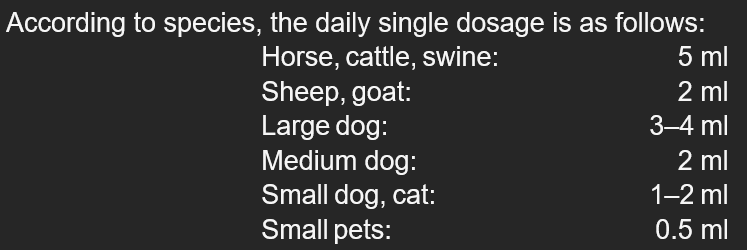
According to species, the daily single dosage is as follows:
Horse, cattle, swine:
5 ml
Piglet:
2–3 ml
Sheep, goat:
2 ml
Large dog:
3–4 ml
Medium dog:
2 ml
Small dog, cat:
1–2 ml
Puppy:
0.5–1 ml
Small pets:
0.5 ml
In cases with acute symptoms, the indicated dosage can be repeated after a period of 24 hours.
Stimulation of the body’s defenses with vascular and sympathetic effect, in viral dis- eases with fever, e. g. bovine respiratory disease, swine influenca, distemper (initial), Herpes-virus-infection, Parvovirus-infection, cat flu, general change of reactivity in skin diseases, eczemas, pruritus, external otitis.
Contraindications: None known.
Side effects: None known.
Interaction with other medications: None known.
Waiting period: None.
Instructions for use, route and duration of administration:
Engystol ad us. vet. is to be administered by s.c., i.m. or i.v. injection.
According to species, the daily single dosage is as follows:
Horse, cattle, swine:
5 ml
Piglet:
2–3 ml
Sheep, goat:
2 ml
Large dog:
3–4 ml
Medium dog:
2 ml
Small dog, cat:
1–2 ml
Puppy:
0.5–1 ml
Small pets:
0.5 ml
In cases with acute symptoms, the indicated dosage can be repeated after a period of 24 hours.
Echinacea compositum ad us. vet. drops are to be administered orally. According to species, the daily dosage is as follows:
Horse, cattle:
3 x 60 drops
Swine:
3 x 40–60 drops
Large dog:
3 x 40 drops
Medium dog, sheep:
3 x 30 drops
Small dog, cat:
3 x 20 drops
Small rodent, cage bird:
3 x 5 drops
If necessary, depending on the severity of the case, the indicated dosage can be re- peated for a maximum of five consecutive days.
Dosage: Echinacea compositum forte S 2.2 ml:
See chapter Dosage of Heel Medications in Veterinary Medicine, p. 17–20.
Package sizes:
Echinacea compositum ad us. vet.: Packs containing 5 or 50 ampoules of 5.0 ml each.
Drop bottles containing 100 ml. Echinacea compositum forte S: Packs containing 10 or 50 ampoules of 2.2 ml each.
Stimulation of the body’s defense systems, in fever and inflammations, like abscesses, furuncles, phlegmons, gingivitis, sinusitis, gastroenteritis, enterocolitis, cystitis, pyelitis, vaginitis, purulent fistulae, osteomyelitis, otitis, skin diseases, mastitis, bovine respira- tory disease, swine influenza, cat flu, delayed recovery period.
Contraindications: Hypersensitivity to one of the active ingredients or excipients or to plants of the daisy (compositae) family. As a matter of principle, Echinacea should not be used in progressive, systemic diseases such as tuberculosis, leukemia or leukemia- like diseases, inflammatory diseases of the connective tissue (collagen disease), autoim- mune diseases, multiple sclerosis, AIDS, HIV infections or other chronic viral diseases. (Echinacea compositum forte S): Because of the constituent Sanguinaria (bloodroot) do not use during pregnancy and lactation. In case of existing liver conditions or history thereof or simultaneous use of hepatotoxic substances use only after consultation with the physician.
Side effects: (Echinacea compositum forte S): Hypersalivation may occur after admin- istration, in which case use of the product should be discontinued. In very rare cases
gastrointestinal complaints or skin reactions can occur – also some days after use. In individual cases, hypersensitivity reactions (up to the anaphylactic reaction) are possible in persons who are known to be hypersensitive to composites (e.g. Arnica, Echinacea). Temporarily, reddening, tumefaction and pain may occur on the puncture site. Skin rash and itching (pruritus), and in rare cases facial swelling, shortness of breath (dys- pnea), dizziness and a fall in blood pressure, have been observed after treatment with products containing Echinacea extracts. Allergic reactions or hypersalivation may occur on account of the homeopathic active substance Hydrargyrum bichloratum (mercury). The medication should then be withdrawn and a doctor should be consulted.
Interaction with other medications: None known.
Waiting period: None.
Instructions for use, route and duration of administration:
Echinacea compositum ad us. vet. is to be administered by s.c. or i.v. injection.
According to species, the daily single dosage is as follows:
Horse, cattle, swine:
5 ml
Piglet:
2–3 ml
Sheep, goat:
2 ml
Large dog:
3–4 ml
Medium dog:
2 ml
Small dog, cat:
1–2 ml
Puppy:
0.5–1 ml
Small pets:
0.5 ml
In cases with acute symptoms, the indicated dosage can be repeated after a period of 24 hours.
Echinacea compositum ad us. vet. drops are to be administered orally. According to species, the daily dosage is as follows:
Horse, cattle:
3 x 60 drops
Swine:
3 x 40–60 drops
Large dog:
3 x 40 drops
Medium dog, sheep:
3 x 30 drops
Small dog, cat:
3 x 20 drops
Small rodent, cage bird:
3 x 5 drops
If necessary, depending on the severity of the case, the indicated dosage can be re- peated for a maximum of five consecutive days.
Dosage: Echinacea compositum forte S 2.2 ml:
See chapter Dosage of Heel Medications in Veterinary Medicine, p. 17–20.
Package sizes:
Echinacea compositum ad us. vet.: Packs containing 5 or 50 ampoules of 5.0 ml each.
Drop bottles containing 100 ml. Echinacea compositum forte S: Packs containing 10 or 50 ampoules of 2.2 ml each.