
BIOLOGICAL THERAPY
JOURNAL OF NATURAL MEDICINE
BT
Reprinted from Biological Therapy, Volume X No. 3, June 1992
Vertigoheel as Administered in Therapy by Internists
Gabriele Herzberger, M.D.
A report by Dr. Gabriele Herzberger, M.D., as prepared from an original study carried out by Dr. G. Brückner.
Approximately one in ten patients who visits an internist suffers from vertigo. For the patients who consult an ENT specialist, the figure is about one in three. As is well known, however, vertigo is a symptom and not a diagnosis. Nevertheless, a very great number of patients with the symptom of vertigo regularly consult a specialist for internal medicine, after having been examined by an ENT specialist who had been unable to determine the cause of the symptom of vertigo.
For these patients, it is important to prescribe a preparation which is characterized as follows:
- Demonstrates good effectiveness with respect to the symptom of vertigo,
- causes no undesired side effects,
- has been tried and proven effective for many years in private medical practice and in hospital use, does not elicit intolerance from patients, does not undesirably interact with other medication, and does not demonstrate incompatibility with alcohol,
- does not have sedative effects.
The preparation Vertigoheel fulfills all of the above criteria.
Table 1 provides tabular representation of an analysis of the component symptoms of vertigo, and the area of action of each of the individual constituents of the combination preparation Vertigoheel.
Table 2 reports on a study involving 118 patients who received concerted therapy for vertigo, and who suffered from this symptom in association with vasomotor vertiginous conditions, cerebrovascular disorders, Commotio cerebri (acute cerebral concussion), post-concussion complaints, Meniere’s Syndrome, and motion-sickness (kinetosis). (See Table 2.)
At the beginning of their therapy, the majority of patients received initial-dose therapy which was administered in the following doses: one tablet each hour, for a period of 6–8 hours. This massive initial therapy was also carried out for patients for whom initial worsening of symptoms took place during early therapy, and for whom external factors (for example, weather conditions and psychic excitement) aggravated their conditions. This was the case for 16 patients.
Table 2 reports on the results of therapy with the patients, with results broken down into symptom classifications, age and sex, and extent of success achieved. Assessment of the therapy results achieved with Vertigoheel:
- There was no recorded case of unsuccessful therapy, nor was there a case in which it was necessary to change to another medication.
- With the exception of patients suffering from kinetosis, a reaction time of several days was necessary — as had been expected — before successful treatment was achieved.
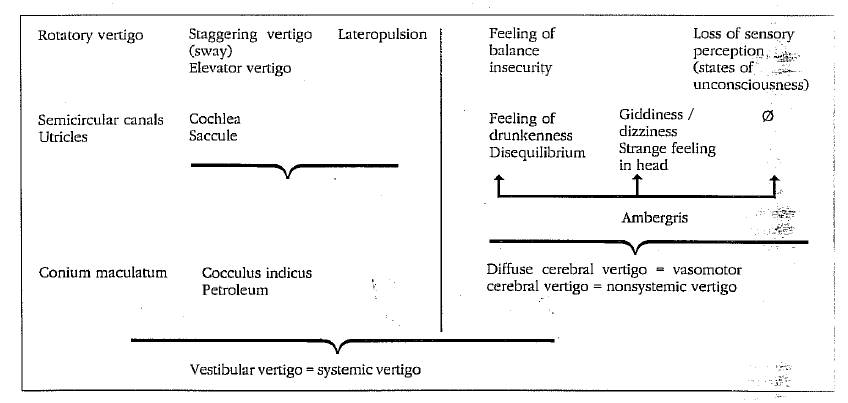
Table 2: Symptom complexes treated with Vertigoheel tablets, the term of therapy, and results of treatment.
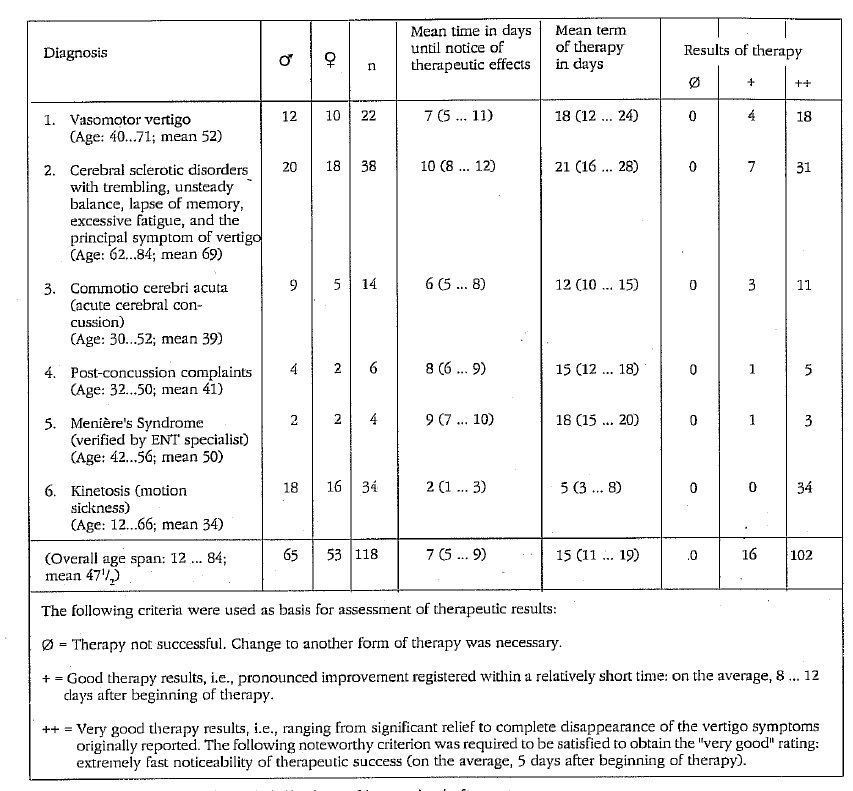
- Owing to the chronic nature of the disorders in classifications 1, 2, and 5, successful therapy was possible only through long-term treatment.
- No undesired side effects or tachyphylactic phenomena appeared. Vertigoheel has no effect on blood pressure.
- Good therapeutic results were achieved even for cases of acute cerebral concussion.
- The term of therapy for the group of motion-sickness patients was restricted to the duration of their individual trips. Medication began for this group 1–3 days before their travel began. Logically, the term of their therapy was considerably shorter than the average for the other groups.
Vertigoheel has proved effective in the therapy of vertigo, especially of central origin. The overall diagnosis comparison reveals that the patients treated with Vertigoheel demonstrated significant improvement in their conditions. This assessment applies equally to patients in all of the following classifications: vasomotor vertigo, acute cerebral concussion, post-concussion complaints, and Ménière’s Syndrome. The effects of Vertigoheel on motion-sickness patients was further analyzed and found to be very good.
Successful therapeutic effects were therefore able to be achieved for all 118 patients – with the absence of any kind of undesired side effect.
Leave a Reply